


Views: 147 Author: Site Editor Publish Time: 2026-05-27 Origin: Site
Driven by both tightening global environmental policies and surging market demand for green building materials, the coatings industry is undergoing a profound transformation from solvent-based to water-based formulations.
Water-based coatings, with water as the core dispersion medium, have fundamentally changed the traditional industry landscape that relied on organic solvents. Their comprehensive advantages in environmental friendliness, safety, and functionality make them the preferred solution in various fields such as construction, industry, and furniture.
The core technology and essential characteristics of water-based coatings
1. Core Definition and System Properties
Water-based coatings, also known as water-based paints or water-dispersible paints, refer to heterogeneous systems where water serves as the continuous phase dispersion medium, and resin is dispersed within it in the form of particles or colloids.
The key difference between water-based coatings and solvent-based coatings lies in the fact that the dispersion medium is water, not an organic solvent. The resin, as the dispersed phase, exists stably in the aqueous system through emulsification, neutralization, or self-dispersion techniques, forming a coating product that is feasible for application.
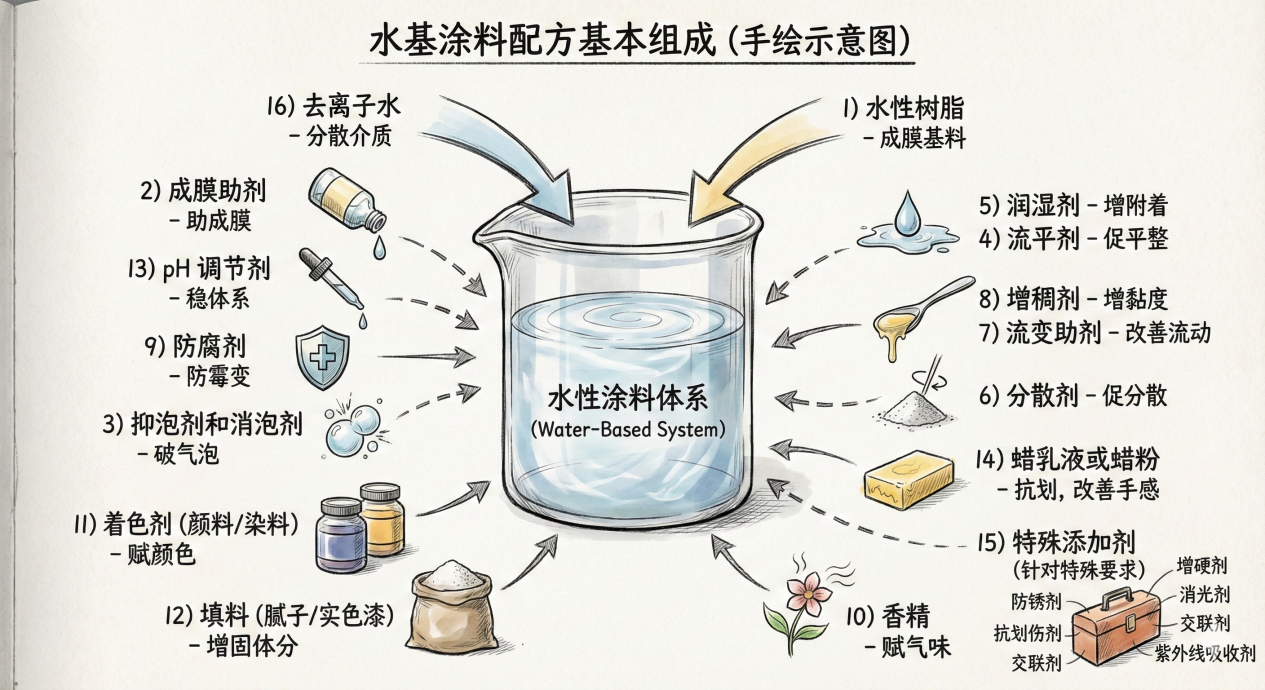
Compared to solvent-based coatings, water-based coatings exhibit significantly different system characteristics:
1.1 System Viscosity:
Viscosity is primarily determined by rheology modifiers (thickeners) that regulate interparticle interactions and network structure, unlike solvent-based systems where viscosity depends mainly on the molecular weight and concentration of the resin in the solvent.
1.2 Film Formation Process:
Film formation is not a simple solvent evaporation process, but a complex physicochemical process involving water evaporation, tight packing of latex particles, and subsequent interdiffusion of polymer chains. This process is significantly affected by ambient temperature and humidity; inappropriate conditions (such as low temperature and high humidity) can easily lead to incomplete film formation and defects.
1.3 System Stability:
Essentially a metastable dispersion system, its stability depends on the neutralization of emulsifiers/surfactants, the hydrophilic groups of the resin itself (such as carboxyl groups), and precise pH control. Formulation design needs to balance dispersion stability with the final coating properties (such as water resistance and mechanical strength), as some stabilizing components (such as surfactants) may remain in the film and affect performance.
2,Water solubility mechanism and film formation principle
The realization of water solubility in water-based coatings does not mean that the resin is actually dissolved in water, but that the resin is made water-dispersible through specific technical means.
Its core mechanisms include three categories:
First, hydrophilic functional groups such as carboxyl, hydroxyl, and amino groups are introduced into the resin molecular chain, and the water dispersion ability is obtained after neutralization with acid or alkali to form a salt;
The second is to stably disperse the resin particles in the water phase to form an emulsion through the interfacial effect of an external emulsifier;
The third is to use self-emulsification technology to make the resin molecules have both lipophilic segments and hydrophilic groups to achieve self-dispersion and stability.
The film-forming process is a key link in the performance of water-based coatings. After the paint is applied, the water gradually evaporates, causing the concentration of resin particles in the system to increase. The particles squeeze and fuse with each other. Under the action of film-forming additives, the resin molecular chains diffuse and undergo physical or chemical cross-linking, eventually forming a continuous and dense coating film. For resin systems with a glass transition temperature higher than room temperature, film-forming additives reduce the minimum film-forming temperature to ensure that the resin particles can still be fully integrated at room temperature or low temperature to avoid defects such as cracking and powdering of the coating film.
3,Core Advantages and Technical Pain Points
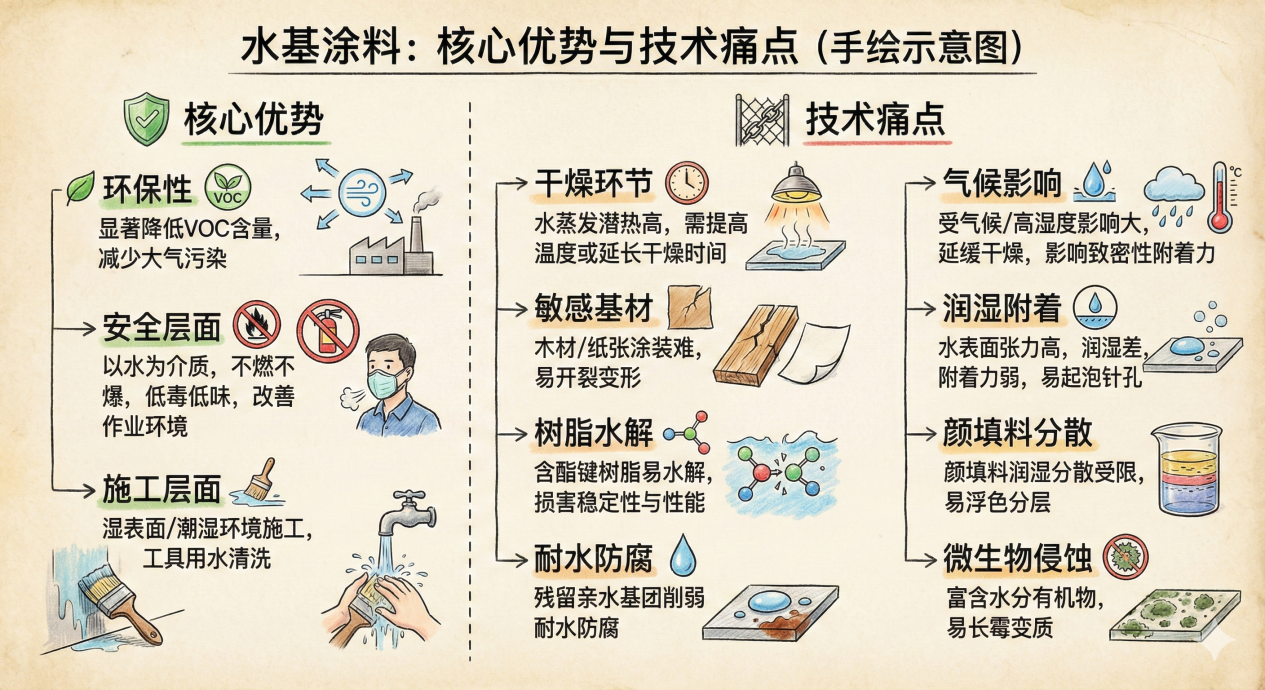
The core advantages of water-based coatings are concentrated in three aspects: environmental friendliness, safety, and application adaptability.
Environmentally Friendly: Compared to traditional solvent-based coatings, water-based coatings typically significantly reduce the content of volatile organic compounds (VOCs), helping to reduce air pollution at the source during the painting process.
Safety: Using water as the primary dispersion medium gives them significant non-flammable and non-explosive properties, greatly reducing fire hazards during storage and construction. Furthermore, because they contain little or no strong solvents such as benzene, esters, and ketones, they generally have lower toxicity and less irritating odor, improving the working environment for construction workers.
Application: They can be applied directly to wet surfaces and in humid environments, have strong adaptability to substrates, and painting tools can be directly cleaned with water, reducing construction costs.
Meanwhile, water-based coatings still face several critical technical challenges that need to be overcome:
Water has a high latent heat of vaporization, which necessitates increasing baking temperatures or extending drying times during the drying process to ensure sufficient evaporation and the formation of a satisfactory coating film.
For sensitive substrates such as wood and paper, the coating process is significantly more difficult, and defects such as cracking and deformation are more likely to occur during application.
Resins containing ester bonds are prone to hydrolysis in water-based systems, which can impair the coating's storage stability and performance.
If incompletely cross-linked hydrophilic groups remain in the coating film, it will directly weaken its water resistance and corrosion resistance, affecting the long-term protective effect of the coating.
Coating The application process is significantly affected by climatic conditions, especially in high humidity environments. High humidity not only noticeably slows down the drying rate of the coating but also negatively impacts its core properties, such as density and adhesion.
Due to the high surface tension of water, the coating's wetting effect on the substrate is poor, resulting in relatively weak adhesion between the coating and the substrate. This also easily leads to common coating defects such as blistering and pinholes during film formation.
Furthermore, water-based coatings have limited wetting and dispersing capabilities for pigments and fillers, often resulting in instability such as floating color and layering.
Additionally, because these coatings are rich in water and organic components, they are susceptible to microbial attack and may develop mold and deterioration during long-term storage or in humid environments.
Classification and key properties of water-based coatings
1,Classification by resin dispersion state
1.1 Water-soluble Coatings
Water-soluble coatings contain resin particles with a diameter of less than 0.01 micrometers, falling within the colloidal dispersion range. They possess the filterability and electrokinetic properties of colloidal solutions. Water dispersion is achieved by introducing hydrophilic functional groups into the resin molecular chain and neutralizing them to form salts. They appear transparent and often require the addition of co-solvents to improve system stability. These coatings have a low solids content (typically 20%–30%), requiring increased wet film thickness during application to ensure dry film performance. They are suitable for applications demanding high film transparency.
1.2 Water-based Coatings
As an important branch of water-based coatings, water-based coatings use water as the dispersion medium. The resin is dispersed colloidally in micelles ≤0.01 micrometers (particle size between water-based coatings and latex coatings, transparent/semi-transparent in appearance, belonging to a multiphase system). During film formation, the micelles fully fuse to form a dense film, combining solution fluidity and emulsion stability. It outperforms traditional latex coatings in gloss, leveling, and hardness. Its core advantages lie in excellent water resistance, outstanding adhesion to various substrates such as metal and wood, and compatibility with multiple application methods such as spraying and brushing. It dries quickly and efficiently. It is widely used in scenarios with high performance requirements, such as metal corrosion protection, wood coating, plastic decoration, and interior and exterior building walls. It is a key development category in the industry, combining the environmentally friendly attributes of water-based coatings with the characteristics of high-performance films.
1.3 Latex Coatings
Latex coatings are water-based coatings formulated with water as the dispersion medium, synthetic resin emulsions (such as acrylic copolymer emulsions) as the core film-forming substance, and supplemented with pigments, fillers, emulsifiers, and various additives. The synthetic resin emulsion, as a key component, directly determines the core performance and characteristics of the coating. This type of coating replaces the organic solvents in traditional solvent-based coatings with water, offering advantages such as low volatile organic compound (VOC) emissions, excellent environmental friendliness, and being non-toxic and odorless, making it more friendly to humans and the environment. Its film-forming principle involves the gradual evaporation of water after application, causing resin particles to aggregate and fuse, ultimately forming a continuous paint film, thus achieving the functions of protecting and decorating the surface of objects. It has a wide range of applications, suitable for coating various substrates such as interior and exterior walls, ceilings, wood, and metal. It is suitable for different scenarios such as home decoration, commercial buildings, and industrial facilities, providing multiple functions such as decoration, protection, moisture resistance, and mildew prevention. With its convenient application, rapid drying, rich colors, and scrub resistance, it has become one of the most commonly used coating types in modern architectural decoration.
2. Classification by resin type
2.1 Waterborne Acrylic Coatings
Waterborne acrylic coatings are environmentally friendly coatings that use water as the dispersion medium and acrylic copolymers as the main film-forming substance. Their core is based on acrylic copolymers generated through the polymerization reaction of acrylate monomers such as methyl methacrylate and butyl acrylate, with water as the dispersant, and formulated with pigments, fillers, and various additives. Based on the resin's state in water, they can be further divided into three types: water-emulsion type, water-solvent type, and water-soluble type. This coating uses water instead of traditional organic solvents, significantly reducing the emission of volatile organic compounds (VOCs), minimizing harm to the environment and human health, and meeting environmental regulations. It is particularly suitable for hospitals, schools, and other places sensitive to air quality. It also possesses excellent weather resistance, UV resistance, water resistance, and gloss and color retention, and dries quickly with strong adhesion. It is compatible with various substrates such as metal, wood, and concrete, and can be used as a primer, topcoat, or sealer. It is a new type of coating that combines the excellent performance of acrylic resins with the environmentally friendly characteristics of water-based coatings, possessing environmental friendliness, ease of application, and outstanding protective and decorative functions. It is widely used in construction, automotive, and industrial corrosion protection, among other fields. 2.2 Waterborne Polyurethane Coatings
Waterborne polyurethane coatings are coatings that use water as the dispersion medium and waterborne polyurethane resin as the main film-forming substance. They cleverly combine the excellent properties of polyurethane materials with the environmentally friendly characteristics of water-based media. Using water as a solvent, they contain almost no organic solvents, significantly reducing the emission of volatile organic compounds (VOCs), making them more environmentally friendly and meeting modern environmental protection requirements. At the same time, they retain the core characteristics of polyurethane materials, such as high wear resistance, chemical corrosion resistance, weather resistance, high elasticity, and good adhesion, forming a tough, smooth, high-quality coating film suitable for various substrates. In terms of application, this coating can be directly diluted with water, and tools and equipment used during application can be cleaned with just water, effectively reducing application difficulty and cost. Its drying speed is relatively slow, but this can be improved by adjusting the formula or optimizing application conditions. Regarding safety, it poses no flammable or explosive risks, significantly reducing safety hazards during application, making it suitable for locations with high safety requirements. Currently, waterborne polyurethane coatings are widely used in construction, furniture, automobiles, leather, textiles, and other fields to achieve diverse applications such as protection, decoration, waterproofing, and wear resistance, making it an ideal environmentally friendly alternative to traditional solvent-based coatings.
2.3 Waterborne Epoxy Coatings
Waterborne epoxy coatings are epoxy resin coatings that use water as a solvent or dispersion medium. They are composed of epoxy resin, waterborne epoxy curing agent, pigments, fillers, and additives. Their core characteristic is that the epoxy resin is dispersed in water in the form of particles or droplets to form a stable system, which then undergoes a cross-linking reaction with the curing agent to form a three-dimensional network structure coating film.
Waterborne epoxy coatings combine the excellent properties of epoxy resins with the environmentally friendly characteristics of water-based media. They offer advantages such as strong adhesion, corrosion resistance, chemical resistance, abrasion resistance, and electrical insulation. Furthermore, they are low in VOCs, non-toxic, odorless, and safe to apply, allowing for application in humid environments. They are widely used in floor coatings, anti-corrosion, wood coatings, waterproofing, and adhesives.
2.4 Waterborne Alkyd Coatings
Waterborne alkyd coatings are environmentally friendly coatings that use water as a solvent or dispersion medium and waterborne alkyd resin as the main film-forming substance. Their core components include waterborne alkyd resin, pigments, fillers, additives, and deionized water. The waterborne alkyd resin is produced by introducing hydrophilic groups such as carboxyl and hydroxyl groups into the traditional alkyd resin molecular chain, enabling it to disperse or dissolve uniformly in water, forming a stable emulsion or solution. The film-forming principle relies on the oxidative cross-linking reaction between the fatty acid molecular chains in the alkyd resin and oxygen in the air. This process is relatively mild and has a slower drying speed, but ultimately produces a film with good adhesion. This coating produces a tough, flexible, and corrosion-resistant film. By replacing traditional organic solvents with water, it significantly reduces volatile organic compound (VOC) emissions, minimizing harm to the environment and human health, and meeting environmental regulations. Its applications are wide-ranging, suitable for anti-corrosion coating of metal substrates such as steel structures, machinery, bridges, automobiles, and ships, as well as for woodwork and architectural decoration. It can be used as a primer, topcoat, or a combined primer and topcoat. It is an environmentally friendly upgrade from traditional alkyd coatings, combining excellent performance, ease of application, and environmental friendliness, and has become an important development direction in the current coating industry.
3. Classification by purpose and construction method
Water-based coatings can be broadly categorized into two types based on their application:
Water-based architectural coatings: These include specialized coatings for interior walls, exterior walls, ceilings, floors, and roofs, primarily using latex coatings (latex-based organic coatings). Other types include water-based organic coatings, inorganic coatings, and organic-inorganic composite coatings. They emphasize environmental friendliness, decorative appeal, and ease of application.
Water-based industrial coatings: These cover specialized coatings for automobiles, ships, containers, furniture, and metal components. They have higher requirements for weather resistance, corrosion resistance, and mechanical properties. For example, water-based automotive coatings consist of four components: primer, intermediate coat, topcoat, and clear coat.
4,Classified by construction/coating method
Coatings can be categorized into electrophoretic coatings (cathode and anodic), dip coatings, roller coatings, and spray coatings. Electrophoretic coatings rely on an electric field to deposit resin particles onto the substrate surface, resulting in good film uniformity and strong protection. Spray coatings, on the other hand, are suitable for large-area, rapid application and require high levels of leveling and atomization performance.

Industry Development Trends and Technological Outlook for Water-Based Coatings
1. Environmental Upgrade: Low-VOC and Zero-VOC Become Mainstream
With increasingly stringent environmental policies, global restrictions on VOC emissions from coatings are becoming increasingly stringent, making low-VOC and zero-VOC water-based coatings a core development trend. On the one hand, improvements in resin synthesis technology reduce the amount of co-solvents used, leading to the development of high-solids water-based resins, such as water-based polyurethane dispersions with a solids content of over 40%. On the other hand, solvent-free synthesis processes and environmentally friendly additives are being used to reduce the volatile organic compound content in the system.
2. Functional Expansion: Multifunctional Integration Becomes a Key Focus of R&D
The market's functional demands for water-based coatings are becoming increasingly diversified. Single performance characteristics can no longer meet application requirements, making multifunctional integration a key direction for technological research and development. For example, architectural exterior wall coatings need to simultaneously possess superior weather resistance, high stain resistance, crack resistance, and self-cleaning functions; industrial anti-corrosion coatings need to balance corrosion resistance, chemical resistance, and temperature resistance; and wood coatings need to achieve a balance between hardness, toughness, abrasion resistance, and anti-yellowing properties. Furthermore, the market demand for specialty functional coatings, such as fire-retardant, mildew-proof, antistatic, and heat-insulating water-based coatings, continues to grow, becoming a new growth point for the industry.
3. High-Performance Breakthrough: Key Performance Benchmarks Against Solvent-Based Coatings
Currently, water-based coatings still lag behind solvent-based coatings in terms of water resistance, solvent resistance, and application adaptability. High performance is the core direction for narrowing this gap. This can be achieved through resin modification technologies (such as organosilicon and organofluorine modification), cross-linking curing technologies (such as room-temperature cross-linking and low-temperature cross-linking), and formulation optimization (such as the application of new additives), improving the overall performance of the coating film. For example, self-cross-linking technology can improve the water resistance of waterborne acrylic resins; nanocomposite technology can enhance the abrasion resistance of the coating film; and low glass transition temperature resin systems can be developed to improve low-temperature application performance.
4. Application Scenarios Expansion: From General-Purpose to High-End Specialized Fields
The application scenarios of water-based coatings are expanding from general-purpose fields such as construction and general industry to high-end specialized fields such as automotive high-end coatings, marine corrosion protection, and aerospace. For example, water-based automotive topcoats have achieved industrial-scale application in metallic paints, exhibiting superior directional performance compared to traditional solvent-based coatings; water-based inorganic zinc-rich coatings are increasingly widely used in long-term corrosion protection applications for large bridges and ships; and water-based wood coatings are gradually replacing solvent-based coatings, dominating the mid-to-high-end furniture coating market. In the future, with continuous technological breakthroughs, water-based coatings will achieve large-scale application in more high-end fields.
5. Intelligent Development: Digital Upgrading of Coating Formulation and Application
Digital and intelligent technologies are gradually penetrating the water-based coatings industry, achieving intelligent upgrades throughout the entire process from formulation design to application. In the formulation design stage, big data and artificial intelligence technologies are used to quickly screen optimal component combinations, shortening the R&D cycle; in the production process, automated control systems are adopted to ensure product quality stability; and in the application stage, intelligent coating equipment is being developed, combining the rheological properties of the coating with application parameters to achieve precise coating, improving application efficiency and coating quality.

As a core direction for the green transformation of the coatings industry, water-based coatings are profoundly changing the industry landscape through technological development and application expansion. From a technological perspective, the water dispersion mechanism and film-forming process of water-based coatings determine their environmental friendliness and application characteristics, while the synergistic effect of resins, additives, pigments, and fillers in the formulation directly affects the film performance. In terms of application scenarios, they have already covered multiple fields such as construction, industry, and furniture, and their application in high-end specialized fields is constantly making breakthroughs. From an industry trend perspective, environmental friendliness, functionality, high performance, and intelligence will become the core driving forces for future development.
For industry practitioners, it is necessary to continuously pay attention to technological innovations and master the core logic of formulation design and the performance requirements of application scenarios in order to gain an advantage in market competition. With the deepening of environmental awareness and continuous technological progress, water-based coatings will undoubtedly usher in broader development prospects, injecting new vitality into the sustainable development of the global coatings industry.
